
Need help? Call us:
+1 (412) 499-1517
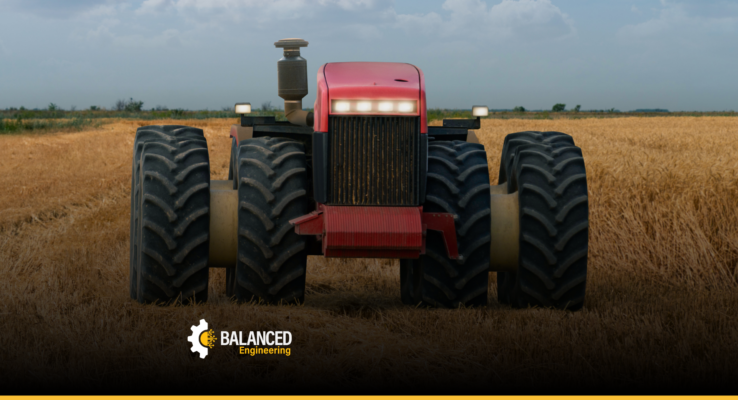
At the recent ASABE AETC (Agricultural Equipment Technology Conference), industry leaders and experts gathered to discuss the next frontiers of off-road technology. Here are highlights key observations on the industry’s direction and the challenges companies will face in the coming years.
The Foundation of Innovation: Risk Assessment Considerations and Product Quality
Developing safe autonomous machines starts long before the software is written; it begins with a structured risk assessment. During the conference, the importance of rigorous methodologies was highlighted, such as those presented by Karl Klotzbach in alignment with ISO 12100.
Working through a systematic “Hazard Loop”—evaluating different risk types such as crushing, pinching, puncture, entrapment, slip, and electrical hazards—along with methods for quantifying and relatively scoring various risks, is what guarantees quality by design. At Balanced Engineering, we advocate that this fundamental risk assessment is the pillar that differentiates a viable innovation from a safety liability.
The Future of the Field: Sustainability and the “Farm to Power” Model
Beyond the continuous mission to feed a hungry world—the central theme of Randy Renze’s keynote on “The Borlaug Mission”—the conference brought to light the intelligent use of land and waste. Solutions such as transferring biowaste into sustainable aviation fuel (the purest of high-grade jet fuels) show the agribusiness potential in the global energy matrix.
Another highlight was the advancement in Agrivoltaics, which is the joint use of land for both solar energy capture and agricultural purposes.While we have all heard of the “Farm to Table” movement, entrepreneurs are now proposing a “Farm to Power” solution. Using the farm for both solar and crop production can provide a very attractive financial model for farmers looking to sustainably use their land and diversify their income potential. However, this adds complexity: the need for smaller machinery to fit between or under the solar panels, making automated systems a very promising option.
Vision Zero and Connectivity: The Intersection of ISO 25119 and ISO 26262
During the AE50 awards, one innovation caught our attention: a system developed by AEF (Vision Zero – Road Safety) helps automobiles to connect and communicate with Ag machines, improving their visibility and notifying drivers to slow down to prevent on-road accidents around corners or blind spots.
This raises a critical regulatory compliance question: would these types of V2V communication systems require Ag machines to also comply with ISO 26262 (the functional safety standard for automobiles) for the communication interface, in addition to the already required ISO 25119?
It is exactly in this complex intersection of architectures and regulations that Balanced Engineering’s expertise operates, translating rigorous standards into clear and safe paths for OEMs.
The Roadmap to Autonomy and Standards Evolution
The path to full autonomy requires coordination between standards committees and industry guidelines due to the complex interactions between electronic systems. The sessions dedicated to Functional Safety / Autonomy, led by experts like Norbert Schlingmann, validated this need.
Some of the highlights were:
- The advancement of NWIP ISO 26604-1, a new proposal presented by Joe Flaugher for Soil Working Machines, which is a Type C standard with recommended AgPlr’s for the defined safety-related functions.
- Changes for ISO 25119, which could be released in 2028: the changes focus on providing flexibility to the machine manufacturer, aligning concepts with ISO 26262, such as Confirmation Measures, AgPlr decomposition, Safety Element out of Context (SEooC), and software qualification.
Translating Complexity into Confidence
The ASABE AETC made it clear that the agricultural industry is advancing rapidly to find more ways to improve products in efficiency and safety. However, navigating the complexities of advanced electronic systems, interoperability, and safety will be key items for advancing this innovative industry.
Companies looking to lead this future without compromising safety, or ROI will continue to look for efficient guidelines, effective standards, and critical advice from industry expert consultants. Balanced Engineering is ready to be the strategic partner that translates regulatory complexity into operational confidence.
Ready to lead the future of off-road automation safely?
Connect with our team to discover how our specialized expertise can optimize your operations and reduce integration risks. Let’s shape tomorrow’s technology and business together.