
Need help? Call us:
+1 (412) 499-1517
Agricultural systems operate in environments that are inherently variable and difficult to control. Soil conditions, weather, crop variability, and human interaction introduce levels of uncertainty that cannot be fully captured through physical testing alone. As a result, traditional validation approaches are increasingly reaching their limits.
In this context, Digital Twins have become a central concept in digital transformation. However, they are still often reduced to simplified notions such as “a model” or “a simulation.”
To understand why Digital Twins matter, it is useful to look at a broader concept: Digital Representations of Physical Systems, which can take different forms, referred to as Digital Models, Digital Shadows, and Digital Twins1.
While often used interchangeably, they represent fundamentally different levels of integration between physical and digital systems.
From Representation to Interaction
The difference between Digital Models, Digital Shadows, and Digital Twins is not in visualization or complexity, but in how data flows between the real and the virtual world.
Rather than viewing these as competing concepts, they should be seen as complementary forms of digital representations, each providing value at different stages of system development and operation:
- A Digital Model is a static representation of a system. Data exchange is manual, and the model does not evolve automatically with the physical system. Digital Models enable early-stage design, architecture exploration, and concept validation. They are lightweight, flexible, and particularly useful when system definitions are still evolving
- A Digital Shadow introduces automatic data flow from the physical system to the digital representation. The system can be monitored in real time, but there is no feedback to the physical world. Digital Shadows enable continuous monitoring and data-driven analysis of real systems, providing transparency into system behavior and support diagnostics and performance assessment in operation
- A Digital Twin establishes a bidirectional connection, where data continuously flows in both directions. This enables not only observation, but also prediction, optimization, and closed-loop control. Digital Twins are essential when systems must adapt dynamically to changing conditions.
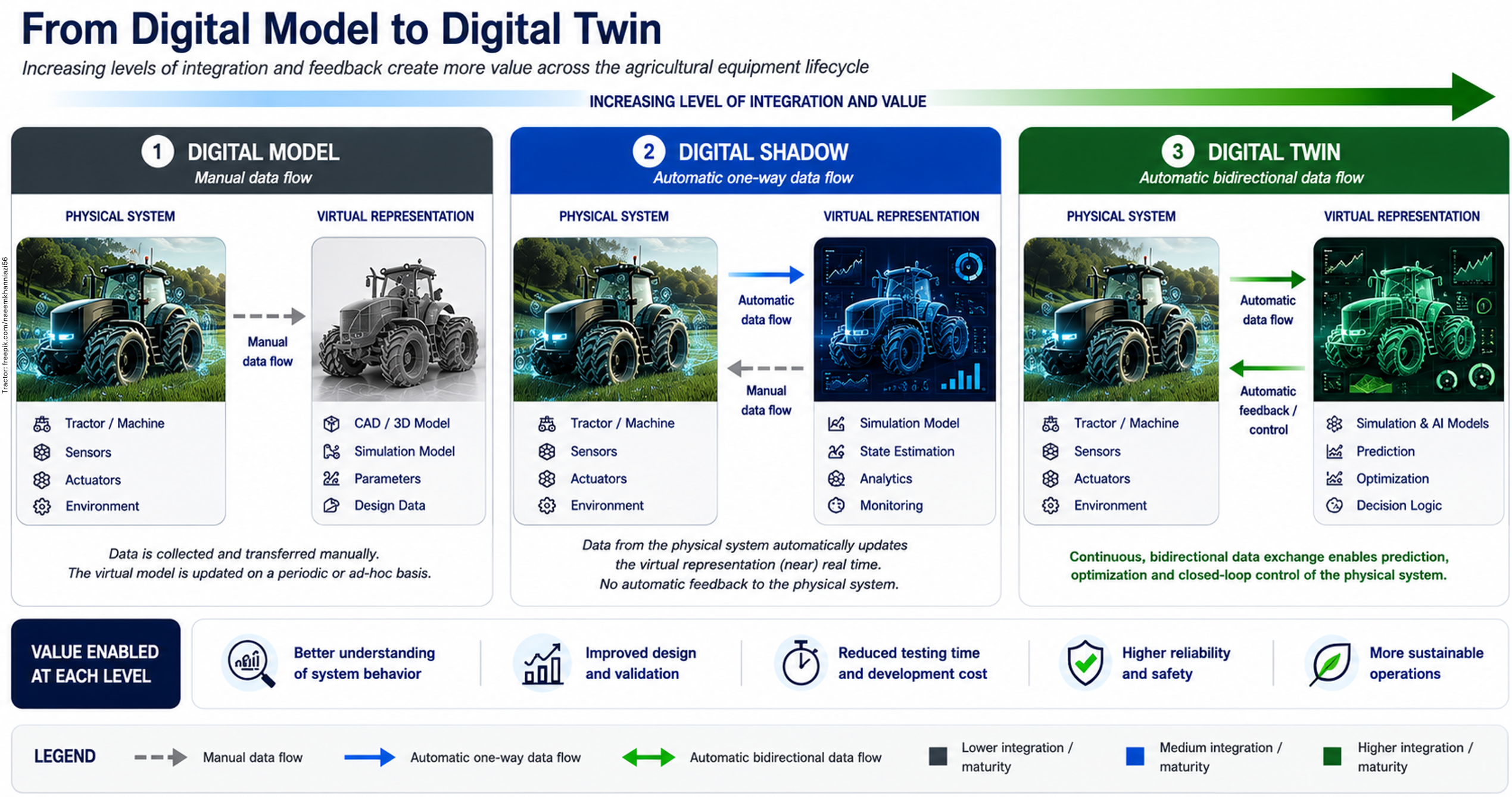
The choice is therefore not binary, but contextual, depending on their functional scope, system complexity, and digital maturity. The organization should be able to select the appropriate level of integration based on system requirements, maturity, and available resources.
Digital Representations as Behavioral and Testable Entities
To fully understand the role of Digital Representations in engineering, it is important to recognize that they are not just connected representations, but behavioral entities. Rather than focusing on geometry or static structure, Digital Representations capture how a system behaves over time, including interactions between software, hardware, communication, and the environment. In domains such as agricultural machinery, this means representing controllers, sensors, actuators, and communication networks as interacting elements within a dynamic system.
In this sense, advanced digital representations can act as digital test instances, where systems are instantiated virtually and evaluated under a wide range of conditions, including not only nominal operation, but also timing effects, interface interactions, and complex system-level dependencies.
Toward Continuously Validated Systems
This shift toward behavioral Digital Representations directly supports a broader transformation in engineering toward continuous validation, where system behavior must be understood not only during development, but throughout operation.
Enabling this level of behavioral representation requires the integration of multiple engineering domains into a coherent execution environment. Through co-simulation, for instance, different virtual models can be coupled and executed together, enabling prediction of complex system behavior, evaluation of system-level effects, and systematic exploration of design alternatives. This also enables capabilities that are difficult to achieve in purely physical testing, such as fault injections across multiple failure modes, evaluation of rare or critical scenarios, and early validation of system integration.
Digital Twins, as the most integrated form of these representations, are foundational for enabling the advent of Physical AI Systems. Physical AI systems are capable of autonomously perceiving, reasoning about, and interacting with the physical world through continuous processing of sensor and actuator data 2.
A Foundation for the Next Generation of Systems
For OEMs and technology providers, this is more than a technological trend. As illustrated in Figure 1, increasing the level of integration in digital representations leads to systems that are continuously connected, continuously validated, and increasingly capable of autonomous adaptation.
By using Digital Representations as digital test instances, engineers can explore a much broader range of scenarios, including edge cases and rare conditions. This enables earlier detection of risks and more robust system design.
In the next post, we will explore how these concepts are applied in practice in agricultural environments, where real-world variability pushes engineering systems to their operational limits.
Would you rather read the article in German? Click here to read it on the blog of our cooperation partner Fraunhofer IESE
CO-AUTHORS:
 Alex Foessel, Ph.D.
Managing Partner | Balanced Engineering LLC
Alex Foessel is an internationally recognized leader in off-road automation, with nearly 25 years of experience advancing autonomy in agriculture and construction. He recently led multi-stakeholder efforts enabling the first autonomous tractor operations in Brazil’s sugarcane industry.
Alex is the co-founder of Balanced Engineering, where he advises OEMs, ag operators, and technology companies on automation strategy, system architecture, and product safety. He also helps shape the industry as a co-organizer of one of the largest agricultural robotics events in the United States.
Before Balanced, Alex spent 18 years at John Deere in global leadership roles across innovation, autonomy, and customer support. He holds a Ph.D. in Robotics from Carnegie Mellon University and is also a cattle rancher in Chilean Patagonia and a licensed private pilot.
 Dr. Pablo Oliveira Antonino
Engineering department at Fraunhofer IESE | Kaiserslautern
Dr. Pablo Oliveira Antonino leads the Virtual Engineering department at Fraunhofer IESE in Kaiserslautern, Germany. He earned his PhD in Computer Science from TU Kaiserslautern and brings extensive experience in the design, evaluation and integration of dependable embedded systems across diverse domains, including automotive, avionics, agricultural and construction machinery and the pharmaceutical industry. Under his leadership, the Virtual Engineering department develops the FERAL platform, which enables the creation of lightweight digital twins of embedded assets and simulation-based virtual prototypes, as well as the application of the Eclipse BaSyx middleware in the pharmaceutical domain. These initiatives contribute to advancing Physical AI — the convergence of physical systems, simulation models, and real-time digital twins to drive prediction, optimization, and continuous validation of complex systems. A further focus of his work lies in continuous engineering, combining simulation-based virtual validation, digital twins, and architecture-centric monitoring to shorten development cycles and enable systems to continuously adapt to change.
REFERENCES:
[1] W. Kritzinger, et al. “Digital Twin in manufacturing: A categorical literature review and classification.” IFAC-PapersOnLine 51 (2018): 1016-1022.
[2] A. Fuller et al. “Digital Twin: Enabling Technologies, Challenges and Open Research,” in IEEE Access, vol. 8, pp. 108952-108971, 2020, doi: 10.1109/ACCESS.2020.2998358.