
Need help? Call us:
+1 (412) 499-1517
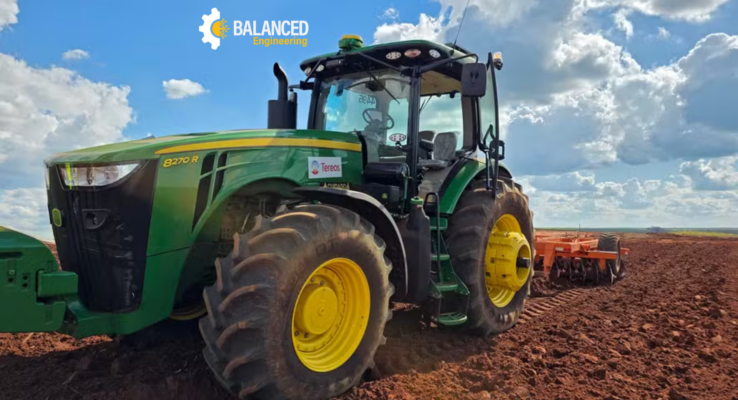
Between May and December 2025, tractors ran fully autonomous in Brazilian sugar-energy fields — no one in the cab — across real sugarcane operations. Tereos and Atvos ran these tests at two mill sites: Cruz Alta in Olímpia, São Paulo state, and Santa Luzia in Nova Alvorada do Sul, Mato Grosso do Sul. The story was picked up by major Brazilian outlets, including CNN Brasil and Globo Rural.
Why this matters
Brazil’s sugarcane industry faces pressures that aren’t going away. Finding and retaining skilled operators is getting harder. The cost of running large fleets keeps climbing. And the expectation to produce more from the same acreage — without expanding into new land — continues to grow. Automation isn’t a futuristic concept here. It’s a practical response to problems that growers deal with every season.
The project traces back to the Agri-Tech Experience, held in the U.S. in October 2024. Balanced Engineering and Agricef organized the trip, bringing Brazilian growers together with American automation companies at FIRA 2024 and through visits to members of the Pittsburgh Robotics Network. That experience led to the formation of the Brazilian Sugarcane Automation Alliance — a working partnership focused on identifying proven automation technologies and putting them to the test under Brazilian field conditions.
How it works
The tests ran on technology from ASI, a U.S. company with over two decades of work in autonomous vehicles across mining, construction, and agriculture. Rather than buying new machines, Tereos and Atvos retrofitted tractors already in their fleets with ASI’s Mobius® platform — a fleet command and control system that lets a single operator manage multiple unmanned vehicles at the same time.
Agricef handled the systems physical integration, drawing on deep knowledge of how agricultural operations actually run in Brazil. According to Globo Rural’s reporting, during Atvos’ soil preparation tests, one person monitored three machines simultaneously from a remote control station.
The operations covered were disc harrowing and subsoiling — soil preparation tasks that make up a significant share of the sugarcane growing cycle.
What the data showed
Over seven months of real-world operation, the numbers told a clear story:
- 20% increase in equipment productivity under the autonomous system
- Up to 10% reduction in diesel consumption
These weren’t lab results. They came from multiple operations across a full agricultural cycle, under real variation in soil types, weather, and field conditions. That matters because it speaks to how the technology performs when things aren’t controlled — which is every day in agriculture.
The testing period also surfaced specific challenges tied to Brazilian topography and operating patterns. Adjustments were made to the system during the validation cycle itself, which means the solution that came out the other end is better tuned for the realities of sugarcane production in Brazil.
Three takeaways for the industry
1. No new iron required. The technology was deployed on existing tractors. That changes the economics of adoption. Growers don’t need to replace their fleets to start capturing value from autonomy.
2. One operator, multiple machines. The labor challenge in agriculture is structural, not cyclical. The ability to have a single person supervise several machines at once directly addresses one of the most persistent bottlenecks in field operations.
3. More output from the same footprint. A 20% productivity gain from the same on the same land is significant — especiall y in a regulatory and environmental landscape where expanding cultivated area is increasingly constrained.
Beyond the operational numbers, the implementation included reskilling mill employees into new roles: autonomous fleet supervision, remote diagnostics, and data management. This is what a responsible transition looks like — automation reshaping the nature of field work, not eliminating it.
Where Balanced Engineering fits in
Balanced Engineering served as the technical consulting firm responsible for creating the alliance including technology supplier, field integration, and producers, validating the technology throughout the testing cycle integrated in the production system. Our work focused on performance assessment, risk identification, and building the framework for these results to support scaling decisions.
As Alex Foessel, Managing Partner at Balanced Engineering, put it: “Adopting autonomy requires more than just buying a solution: it demands operational readiness and alignment with the grower’s business. Balanced Engineering guides clients end to end to transform technology into value — supporting decisions and execution — and building the conditions for consistent results at scale.”
What comes next
Tereos and Atvos have signaled that the next phase will focus on usability improvements and expanding the range of operations covered, with an eye toward consistent gains at scale. For the broader sector, these tests set a concrete benchmark: autonomous field operations in sugarcane are technically viable, they produce measurable results, and they can be deployed on infrastructure that’s already in place.
Sources: