
Need help? Call us:
+1 (412) 499-1517
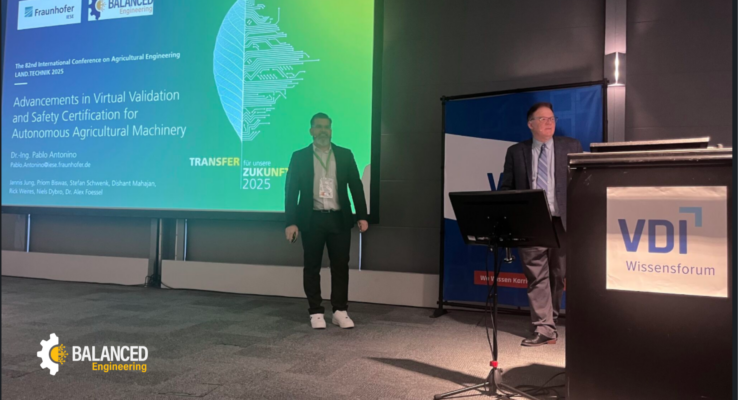
The agricultural sector is undergoing significant transformation, driven by automation and robotics. Events like the VDI Landtechnik conference provide important platforms for industry experts, researchers, and innovators to discuss advancements and address challenges. At this year’s VDI Landtechnik, discussions focused on two key areas where the large-scale agricultural autonomy sector is concentrating its efforts: ensuring safety for large autonomous equipment and improving the practical utility of these machines. While autonomous navigation is well-established, enabling these machines to perform complex tasks without human supervision remains a significant challenge.
For OEMs: RobThe Dual Focus of Agricultural Autonomy: Safety and Practical Application ust Product and Global Compliance
Rick Weires, co-founder and operations partner at Balanced Engineering, attended the event and shared his reflections on the discussions at VDI Landtechnik. His insights highlighted how automation is reshaping sectors like agriculture and construction, emphasizing strategies for efficient integration and risk management. The discussions centered on two main challenges in agricultural autonomy:
1-Ensuring Safety in Large Autonomous Equipment: Modern agricultural equipment requires high safety standards. The industry is still working to establish a supplier base for detection systems capable of identifying humans, animals, and hazardous objects that may interact with these machines. While the ISO 18497 standard, “Agricultural machinery and tractors — Safety of highly automated agricultural machines — Principles for design,” provides a framework, its reliance on risk assessments often leads to complex, open-ended challenges. Developing machine learning training datasets to cover all conceivable scenarios is a difficult task, and the standard lacks clear limits for what constitutes acceptable risk. This is particularly relevant given the diverse and unpredictable nature of agricultural environments.
2-Improving the Practical Utility of Autonomous Machines: While large machines can traverse fields following predefined patterns, the challenge lies in ensuring they perform their primary tasks effectively and autonomously. Operations such as precise soil preparation or efficient grain cart management, though seemingly straightforward, involve automation complexities that go beyond simple navigation. A machine must execute its core function with the precision, adaptability, and reliability of an experienced human operator, even under varying field conditions.
About Rick Weires, Co-Founder at Balanced Engineering
Rick Weires, co-founder and operations partner at Balanced Engineering, has over 15 years of experience in automation and robotics supporting multiple OEM’s and their suppliers. His expertise lies in solution integration and functional safety, making him a recognized expert in the field which predated the recent push towards autonomy. Rick and his team take a practical approach to problem-solving: many of Balanced Engineering’s systems engineers are active farmers themselves. This combination of theoretical knowledge and hands-on experience ensures that their solutions address the real-world needs and challenges faced by farmers. You can connect with Rick on LinkedIn.
Participation at VDI Landtechnik
At VDI Landtechnik, Rick highlighted how Balanced Engineering is addressing industry challenges with a pragmatic approach. In collaboration with Pablo Antonino from Fraunhofer IESE, they presented their work on digital twin technology, focusing on the following key areas:
- Proprietary Risk Assessment Methodologies: Balanced Engineering has developed methodologies to manage risk assessments. These approaches establish clear and manageable limits, ensuring safety without compromising operational efficiency. This method provides actionable insights and a structured path to compliance and safe operation.
- Systems Engineering for Practical Tasks: Balanced Engineering collaborates with Original Equipment Manufacturers (OEMs) to deliver systems engineering solutions. Their work enables a variety of agricultural tasks to be performed autonomously, including soil preparation and grain cart management, with precision and reliability. These solutions are designed to meet the specific needs of farmers.
- Leveraging Digital Twin Technology with Fraunhofer IESE: To enhance their offerings, Balanced Engineering partners with Fraunhofer IESE, a specialist in modeling complex mobile systems. By utilizing Fraunhofer IESE’s digital twin solutions, including its proprietary FERAL, Balanced Engineering simulates and optimizes autonomous operations. Pulling in data and models from a wide range of external tools. This collaboration ensures that solutions are rigorously tested and refined in a virtual environment before real-world deployment, improving efficiency, effectiveness, and development timelines. Once the machines reach the real-world, updates to designs are greatly accelerated with better customer outcomes.
About the Event: VDI Landtechnik and the Agricultural Landscape
The VDI Land.Technik Ag/Eng 2025 conference in Hannover, Germany is a premier event in agricultural engineering, preceding the largest agricultural exhibition in the world, Agritechnica 2025, held on the same site. VDI brings together experts to present and discuss advancements in farming technology and address the practical implications of integrating these innovations into agricultural operations. Everything in autonomous agriculture from the largest OEMS and to the smallest supplier is presented and well-choreographed sessions. Presentations were numerous on obstacle identification as well as how to compare solutions in actual field conditions. Professors from the top agricultural universities across the globe are there to share the latest insights from academia. These forums provide an essential venue for fostering collaboration, sharing knowledge, and accelerating the development of solutions that will define the next generation of agricultural machinery.
Balanced Engineering: Your Partner in Agricultural Autonomy
At Balanced Engineering, we specialize in helping companies integrate advanced automation solutions efficiently, ensuring safety, compliance, and measurable results. Our deep understanding of agricultural autonomy, combined with practical experience and strategic partnerships, positions us as a trusted partner in this evolving field. We assist clients in navigating the complexities of integrating emerging technologies into practical and profitable operations, ensuring that investments deliver value and contribute to a safer, more productive agricultural sector.
Conclusion: Advancing a Safer and More Productive Agricultural Sector
The discussions at VDI Landtechnik reinforce the importance of addressing safety and practical application in agricultural autonomy. Rick’s insights, supported by Balanced Engineering’s methodologies and partnerships with organizations like Fraunhofer IESE, provide a clear path forward. Our solutions are designed to meet industry standards while addressing the practical needs of farmers, driving productivity, improving safety, and fostering sustainable growth in the agricultural sector.
Explore the potential agricultural automation for your business. Visit our website at Balanced to learn more or contact us directly to discuss your specific needs.